Why We Built Quraite
We've been building conversational agents for internal and client use cases. The biggest lesson for us is that iteration is where everything breaks down.
Agents are already hard to get right. Conversational agents are harder because they don't fail in a single step. They fail across turns, in ways that only emerge through dialogue. If something goes wrong at turn five, you have to replay turns one through four every time you make a fix. Multiply that across different user personas and scenarios, and iteration becomes slow, frustrating, and expensive. In practice, this friction leads teams to ship anyway, hoping the failures won't matter.
We learned the hard way that they do.
When we talked to other teams, we found the same pattern: most developers rely on what we call vibe evaluation - manual testing, gut feel, informal judgment. We're not against vibe evaluation. It's fast, intuitive, and human-aligned. The problem is that it disappears. There's no memory, no regression safety, no way to learn systematically from what went wrong.
What Quraite does
Quraite turns vibe evaluation into a living test suite.
Instead of throwing away manual testing, we capture it. A conversation that "felt wrong" becomes a structured test case. A production failure becomes a regression test. Over time, these accumulate into an evaluation set that reflects real user behavior, real edge cases, and real failure modes.
Here's what that looks like in practice: you're testing an agent and notice it handles a refund request poorly on the fifth turn. In Quraite, you flag that conversation. The system saves all five turns as a test case, along with the expected agent behavior. The next time you change your prompts or swap models, you can replay that exact scenario in seconds and evaluate the agent's behavior at every turn. Because a wrong step at turn two compounds by turn four, Quraite lets you catch agent trajectory failures early and not just check the final output. No manual re-typing. No trying to remember what the user said. The conversation is preserved, ready to run whenever you need it.
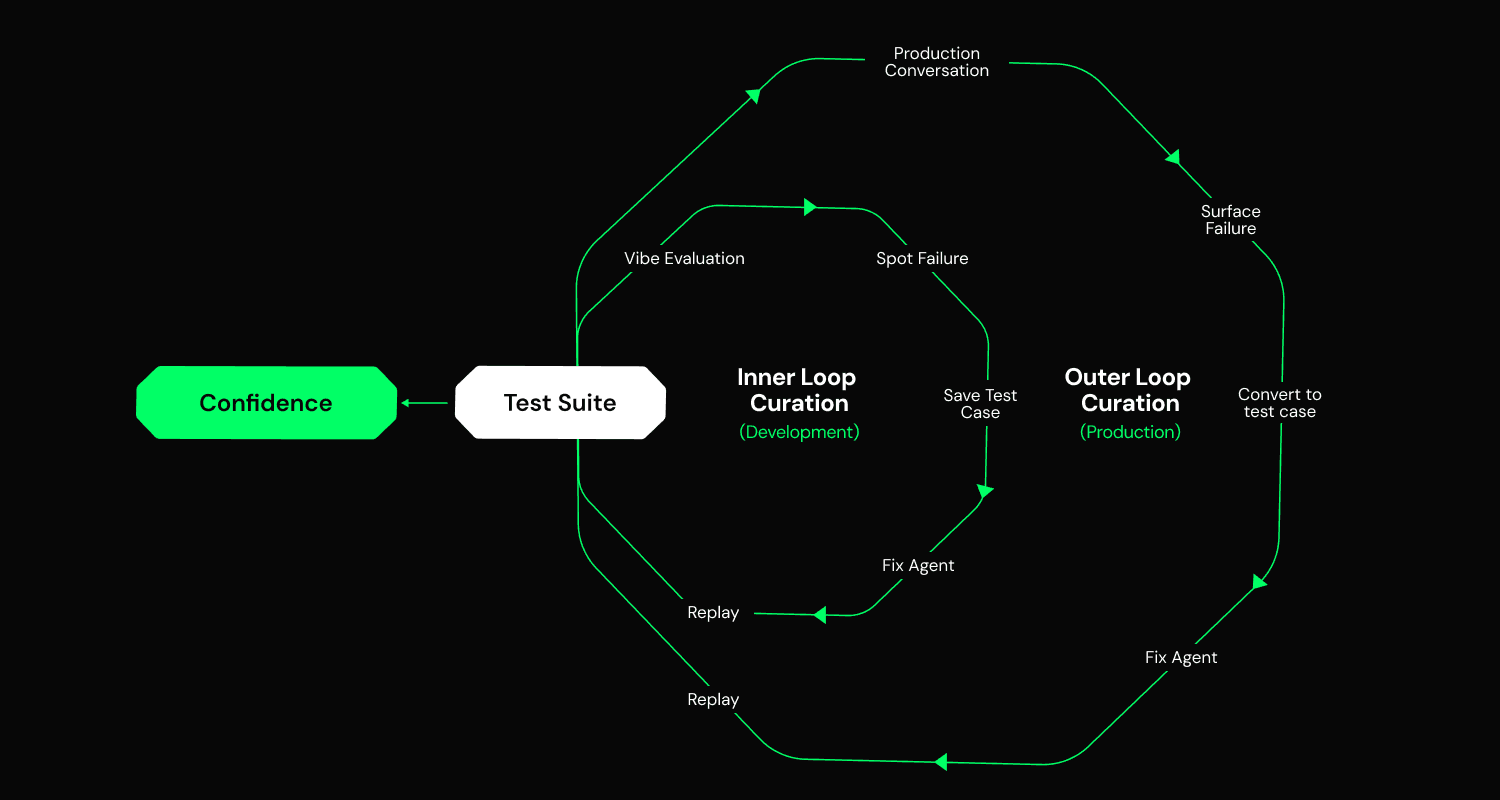
This curation happens at two levels:
Inner loop curation is what happens during development. As teams test and iterate, Quraite helps them capture test cases in the moment. A failed conversation becomes a deliberate improvement - not something you forget by the next sprint.
Outer loop curation is what happens in production. Real user interactions surface failure patterns you never anticipated. Quraite lets you convert these into test cases, continuously enriching your evaluation set with evidence from the field.
Together, these loops build confidence over time rather than assuming it on day one.
How it works
Quraite gives you three ways to curate your test suite:
Curate scenario-based tests to describe how users behave - their persona, context, and goal - along with how the agent should behave in natural language. Quraite simulates realistic user messages and evaluates the agent's trajectory turn by turn. If the agent fails at turn two of a ten-turn conversation, the test stops immediately. No wasted time or tokens.
Curate script-based tests to replay exact conversations. When you're debugging a specific production issue or validating a fix, you want precision, not variation. Script-based tests give you full control over every user message.
Curate metrics to evaluate what actually matters. Generic metrics like "helpfulness" or "hallucination rate" don't mean much - helpful for a travel agent is different from helpful for a financial advisor. Define metrics that reflect your actual requirements: brand voice, tool usage, compliance, task completion, whatever matters for your product.
Why this matters
Even deterministic software has bugs. Stochastic systems have more because unlike unit tests, the input and output space in natural language is infinite. Conversational systems fail in less predictable ways. The only sustainable approach is to treat evaluation as a living artifact, not a one-time checklist.
Confidence in an agent isn't something you assume. It's something you build, conversation by conversation.
We built Quraite because we needed it. If you're shipping conversational agents and want to iterate faster without sacrificing confidence, try it out or get in touch.
"Treat your agent like an untrusted worker.
Curate your confidence, don't assume it."

© 2025 Quraite